
Contents
Introduction
Quality Assurance (QA) is a process-centered approach to ensure we are providing the best possible products or services. It is related to quality control (QC), which focuses on the end result, such as testing a sample of items from a batch after production. Although these terms are sometimes used interchangeably, quality assurance focuses on enhancing and improving the process that is used to create the end result, rather than focusing on the result itself.
Quality Control
Quality Control (QC) entails the basic procedural and statistical management of quality; it is management-driven and focused on eliminating defects in processes and products. Que3st is a QC program. QC is inherently an after-the-fact evaluation of products and services produced in order to identify and isolate any defects inherent in the product or service. QC is needed because we don’t always do things right every time and errors need to be spotted so they can be corrected.
Limitations of Quality Control
QC metrics can be useful in process cost control and cost avoidance but may not be adequate to determine lost opportunity costs of failing to meet a customer’s quality expectation. In example, we may execute a contracted menu flawlessly hitting product cost targets and adhere to all safe food handling procedures and present the food in a first class manner but if the product offered does not meet customer expectations we may lose future sales. QC is not designed to capture and identify the costs of failing to meet customer expectations and therefore, a business unit could have high QC scores and still experience declining sales and margins because of other factors impacting customer touch points and interactions.
Quality Assurance
Quality Assurance (QA) has a greater emphasis on achieving user satisfaction through customer-driven quality characteristics. QA is inherently customer-driven and focused on achieving 100% satisfied customers. The biggest problem isn’t that we can’t meet customer’s quality requirements; it’s that we often don’t know what the customer’s quality requirements are. QA focuses on understanding customer perceptions of quality and enhancing the process that is used to create the end result, rather than focusing on the result itself.
QA verifies that any customer offering, regardless of whether it is new or evolved is produced and offered with the best possible materials, in the most comprehensive way and with the highest standards.
The Centerplate Way and Total Quality Activities
Quality Assurance is a key element of the Centerplate Way. The following diagram represents the various processes and events that contribute to achieving 100% Customer Satisfaction. The cycle is continuous and designed to inform our training and investment strategies to allow us to meet and exceed customer expectations.
Quality Assurance Tools
There are many QA tools that we can use to help guide us through the steps that are needed to ensure that our processes are as efficient and productive as possible. One of the most popular tools is called the Shewhart cycle, which was developed by Dr. W. Edwards Deming, a 20th-century American management consultant who named the tool after his associate, Walter A. Shewhart. This cycle for quality assurance consists of four steps: Plan, Do, Check and Act (PDCA). At the end of Shewhart cycle, which also is called the Deming cycle or PDCA cycle, the steps are repeated to ensure that the process is being evaluated and improved on a constant basis.
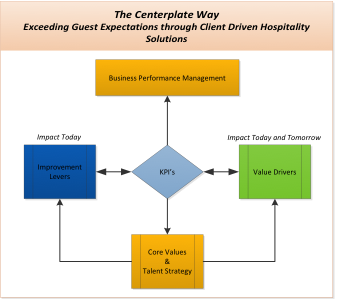
Centerplate has an opportunity to develop an industry competitive advantage by focusing on Quality Assurance in a comprehensive way. We are already light years ahead in our Centerplate Stir Design process; inherently customer centric, it can be woven into a quality assurance program to reduce variation between customer expectations and the products we bring to market. Critical is an integrated quality assurance program to drive continuous improvement through the assessment and monitoring of key performance indicators [KPI’s]. KPI’s will be structured to define core operating processes that in turn define Centerplate; in essence they bring the “The Centerplate Way” to life in a way that is tangible to clients and to our team members.