
Contents
- The Importance of Plate Presentation
- Elements of Plate Presentation
- The Application of Garniture
- Integrated and Added Garniture
- Chef Tip – Crisp Garnishes
- Fried Vegetable Garnishes
- Dehydrated Garnishes
- Elements of Design
- Balance
- Focal Point
- Flow
- Strong Lines
- Applying Presentation Concepts
- Theme and Style
- Practicality and Function
- The Mechanics of Presentation Design and Implementation
- Sequencing
- Access
- Conclusion
The Importance of Plate Presentation
Plate presentations initially entice the diner visually. The first impression of the dish will likely influence all other aspects of its appraisal. The diner is stirred by a carefully planned array of visual stimuli. Ideally, those stimuli will be both visually pleasing and suggest much about the dish. The presentation should clearly define the dish. It might also suggest a theme, a cuisine, or the chef’s intent to present a specific combination of flavors, textures, and colors as his or her creation. The presentation suggests that these combinations of items purposely unite into a well thought out and successful dish. It implies that these items go together as a sum rather than merely a plate of individual items.
In this chapter, presentation concepts are applied to individual items, dishes, and larger multi-serving presentations such as buffet platters. The concepts are specifically relevant to each of these types of applications and are fundamental throughout the general process of presentation development.
Elements of Plate Presentation
Successful presentations encompass an array of elements including the thoughtful use of color, texture, flavor, shape, size, height, and aroma. Each of these elements is an individually powerful tool to any designer of plate presentations. They are important in the creation of a tempting dish. Used in combination with each other, they provide an infinite assortment of diner-pleasing possibilities. A dish that only considers one or two of these elements will never live up to its potential. Masterful application of these combinations result in plates recognized as outstanding.
Color
Color is one of the first elements many consider when evaluating a presentation. “Look how colorful the dish is” or “this dish needs some color” are common assessments. Many times an evaluator will quickly determine that a specific color such as green would improve the dish. Color evokes impressions from festive and fun to traditional and formal. It may suggest elegance, heartiness, naturalness, seasonality, and even good cooking technique. Light and bright colors catch one’s eye and often determine the item seen first. This can be especially useful when it is important to focus attention on an ingredient or item and when directing the flow of a diner’s eye around the plate. Color selection should consider issues of item appropriateness in such areas as the dish, the theme, the season, the region, and cuisine. Color cannot be added for color’s sake alone. It is a thoughtful addition integral to all aspects of the plate. Ideally, color issues are best addressed through the major items of the dish and not simply through the addition of garnish. However, sometimes the provision of added garnish is an appropriate and useful way to add color. This is especially true when other elements such as texture and flavor are also improved.
Texture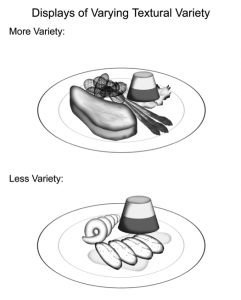
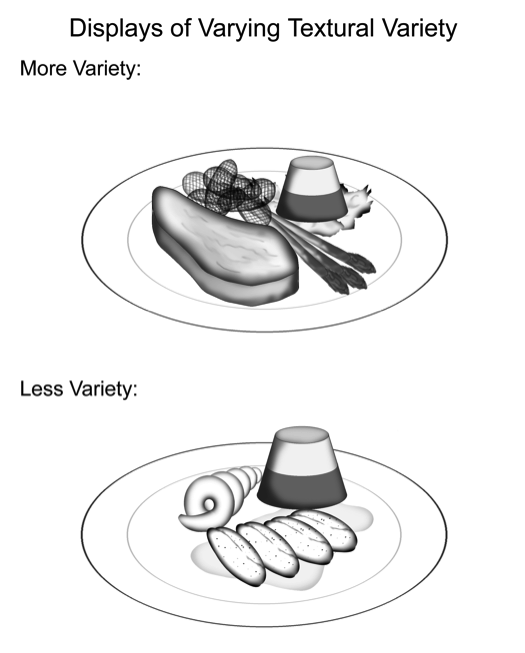
Texture is important to plate presentation because it is visual as well as tactile. Designs made by textural ingredients often add visual appeal. Texture also determines the structure of items and will affect how they are displayed. For example, certain structures promote the development of height. Texture is another element with which to create variety. Variety is important to promote interest. A plate of only pureed food would be uninteresting indeed. Its insipid nature would be observed before it was tasted. A variety of anticipated mouth-feel sensations will add to the appeal of a dish even before the first bite.
Flavor
While flavor issues may seem unrelated to a discussion of presentation, they are important nevertheless. Diners can observe, knowing from experience, whether flavors represented on the plate go together. In this way, flavors are visual. Further, certain flavors may be particularly appealing to a diner and a presentation representing those flavors would be especially stimulating. For example, the pleasant sweet flavor represented by a piece of fruit is as important to a diner’s perception of a presentation as the shape and color of the fruit itself.
Shape
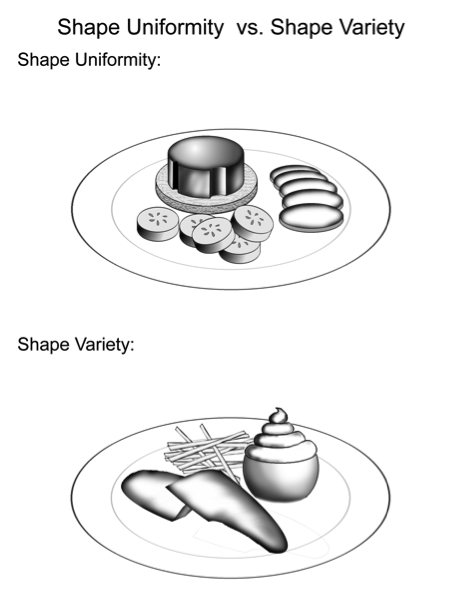
The creation of presentations has much to do with the placement of shapes. Individually interesting, combinations of shapes can be even more so. Artistic use of shape results in professional and admired presentations.
Shapes can occur naturally, from different types of ingredients and cooking techniques, or they can be created artificially. For instance, the fillet of a small fish such as a trout has a naturally distinctive shape. That same fillet could be rolled, sliced or even shredded into other useful and attractive shapes. Portions can be created in ways that utilize or even mimic a natural shape. A tranche slice of fish fillet is an example. Though not a naturally occurring piece of fish, it is cut on a slant and bias in such a way as to suggest that it is. The alternative would be to create unnatural but interesting geometric shapes such as squares, triangles and circles. Both approaches could produce great presentations but will give different impressions. Their use should be intentional rather than happenstance to convey in a controlled way what is intended about a dish or presentation. Is the dish modern or classic, complex or simple, identified by its parts or an assembly of less identifiable parts?

Shapes are best accentuated by the considered use of void space. Such space allows the outline of the shape to stand out and be seen. Lack of void space creates a jumble without individual definition. Interesting elements can be lost in the array. The clean lines and interesting elements made apparent amid the void spaces create presentations that are appealing and elegant.
The capable cook uses a number of skills to apply shapes effectively within a presentation. First, an awareness of products and their properties allows the greatest application of their attributes of shape to the dish. Artistic planning skills allow for unique and creative treatment of shapes. Knife skills and machines can be used to create a number of interesting shapes from foods. There are a broad array of classic shapes often applied to vegetables and other foods. Fabrication and formulation skills further promote optimum potential of presentation design. In the end, skills such as these combined with purposeful design generally result in presentations of the highest quality.
Size
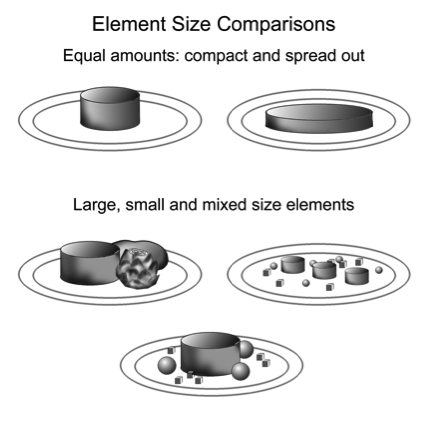 The application of size concepts, like other elements, requires a developed skill and an understanding of intended results. Consideration of size combines function and impression. There are no absolute rules, but instead guidelines, common sense and tradition to assist the culinarian. Large elements attract attention. Very small elements are often seen as elegant and refined. Small elements can be lost among larger ones. Large elements either can inspire awe or be seen as inappropriate. Value (real and perceived), style, item purpose, and even nutrition will influence decisions of item and display size. It is important to make the presentation appear to be of good value. It is important for dishes to serve their purpose. An appetizer should not fill the diner up. A hors d’ oeuvre should be only a bite or two. An entrée with a disproportionate amount of protein may put off today’s health-conscious diner.
Artistic considerations will play a role in selecting the size of major and minor elements of a presentation. Not only will control of entrée, appetizer, or hors d’ oeuvre size advance intended results, but so too will control of the size of components making up those items. Nuts used for garnish might be kept whole or chopped. The grind of meat within a pate or sausage can determine its style. A large dice of colorful vegetable might be more visible than a brunoise. With so many options and no absolute answers, the culinarian must take care to address all the possibilities in order to achieve the desired results and to be consistent in practice.
Shape can be used to manipulate perceptions of size. An item can be compact or spread out. At times, the desired effect may be that of concentration. Other times, the same amount of product will appear larger if presented in a shape that spreads itself over a larger area. A thick dense steak, sliced thinly and at a bias, can cover a platter rather than a plate. Thinly cut shoestring potatoes from a single tuber will appear much larger in amount than that same potato simply baked. A quarter pound of chipped ham will look like a lot more than a quarter pound of thickly sliced ham. Thinly slicing, finely cutting, shredding, cutting on the bias, pounding out, and butterflying are all ways to make items appear larger. If the opposite effect is desired for a presentation, then fabrication of dense items that are closer to equal height, width and breadth should be undertaken.
Height and Dimension
Height gives a presentation greater dimension. The added dimension of height is pleasing to the eye. A dish or presentation without height is said to be flat or two-dimensional. Therefore, some element of height is generally attempted when developing a presentation. Contemporary presentations often employ wispy flourishes on top using items like fried thinly sliced vegetables, long thin pastries or, for desserts, long strands of pulled sugar. While these garnishes can be effective and elegant, much can be done to the elements of a dish or presentation itself to create height.
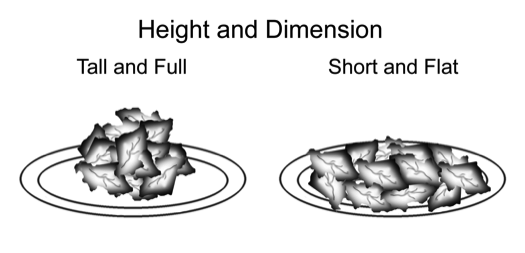
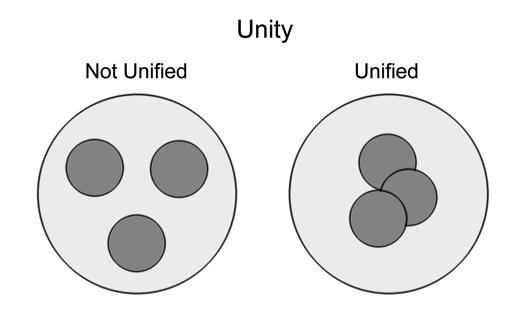
Many of the concepts already discussed assist in the development of height within a presentation. Using thick shapes or stacking thin shapes promote height. Bringing the mass of a dish together might both create height and void spaces on a plate. The same amount of salad greens, for example, could look flat and sprawling or be brought together to create a presentation that is tall and defined. Combining separate elements of a presentation into a unified assembly, a concept further discussed later in this chapter (unity), aids in the creation of height in much the same manner.
Aroma
While the relevance of aroma to a discussion of presentation may not be initially apparent, aroma indeed plays an important role in a diner’s perception of a dish or presentation. It cannot be separated from that of a diner’s initial impression and continued enjoyment of a dish. A pleasing aroma can stimulate our taste buds and build anticipation and expectations of a dish even before it is seen. Conversely, a foul or offensive odor, sometimes even an unfamiliar one, can irreparably taint our perception of a food item.
With forethought, a culinarian can utilize aroma to great advantage. Consideration of those aromas naturally associated with an item combined with skillful application of complementing spices and aromatics will build not only the flavor of a dish, but also its ultimate aroma. Aware of the impact, a shrewd cook can accentuate those aromas most likely to be perceived as positive. In some presentations, aroma plays a dominant role. Dishes served en papillote, or cooked in a bag, are an example of this. They are brought fully cooked yet still contained within the bag into the dining room for presentation. At the tableside, the bag is pierced to allow the aromas to escape for the diner’s enjoyment. The bag, while interesting, is not that beautiful. Combined with the pleasing aromas, however, the presentation becomes memorable.
For these reasons, aroma becomes a tool of presentation. The question of a dish’s aroma should be given careful evaluation, accentuating that which is positive and avoiding potentially offensive odors.
The Application of Garniture
One means of successfully addressing issues of color, texture, flavor, shape, size and aroma is through the effective use of garniture. Often thought of as merely visual decoration, it is in fact much more. Garniture is embellishment or enhancement that incorporates the visual, taste, and textural elements of a dish or presentation. When it addresses only one of these elements, it will often be found to be out of place or at least to have less impact on the dish than desired. To add a garnish for color alone affects the presentation solely in a visual manner without other connection or contribution to the dish. Parsley is a great example of this. Often added for that touch of color, it is generally scraped aside and ignored providing no further function. Sometimes garnish added with consideration of only one element does not make sense with the dish and can even detract from it. Adding a chilled strawberry to a grilled steak for vibrant red color would be such an example.
Garnitures that simultaneously engage the elements of appearance, flavor, and texture add complexity and interest to the dish. Not only will it look more vibrant and interesting, there will be additional flavor that complements or contrasts the dish and there will be interesting textures or mouth feel as one consumes the dish. Such garniture reveals a high degree of culinary talent and sophistication. Strawberries added to an ice cream sundae would make more sense than one added to an entrée such as steak for color alone. Here the garnish adds bright color, a delicious and complementing flavor, and an additional fleshy texture alongside the creaminess of ice cream. From a diner’s point of view, strawberries are often associated with ice cream but rarely a grilled steak. While the sweet and savory combination may not be terrible, will it be better than the flavor of the steak without the strawberry? Most diners will think not. More likely, it will seem strange, possibly confusing and once tried will not be deemed a superior experience. An even more sophisticated garniture might be to make compote of the strawberries for inclusion with the dish. This would highlight cooking technique and better integrate the garnish into the other elements of the dish. All of this would be accomplished while addressing appearance, flavor, and texture.
Effective garnishing is accomplished through the thoughtful selection of ingredients and presentation components. Different ingredients have unique characteristics of appearance, flavor, and texture. Consider not only the characteristics of an ingredient as purchased but its potential characteristics when prepared as it might be. A carrot can be crisp, al dente, mushy, pureed and even juiced. Cuts from it can range from large to extremely fine. Experience and education will help the creator of a dish or presentation to combine these elements in interesting ways. The entire dish or presentation, even the entire menu must be considered. It is said that variety is the spice of life. Variety also “spices” or adds interest to dishes and presentations. Variety can be created within each element of taste, texture, appearance and even cooking technique to make dishes, presentations and entire menus more enticing. Repetition of textures, colors, and flavors will result in offerings less interesting as a whole than are their individual parts. A plate of entirely fried food, generally brown in color, all crispy in texture and possibly greasy in taste would indeed be mediocre. Yet, any item off the plate in combination with food of other characteristics could be stellar.
Further interest can be added to presentations by combining not only various ingredients but also various culinary components or techniques. Contributions from all areas of the kitchen are at a culinarian’s disposal. Baked items can be used to add crunch or chewiness, to create a base or an interesting shape and height. Custards allow for a silky smooth texture, hot or cold, of unlimited flavor, color, shape, and size. Charcuterie items can also be made into nearly unlimited shapes, sizes, flavors, and textures. They can be combined with pastries for additional complexity and interest. A salad as part of a dish or presentation often complements more savory and dense items.
Finally, consideration of the concepts of contrasting and complementing elements is important. Both of these elements are powerful tools in the development of dishes and presentations. When choosing components to combine within a presentation, including those of garnish, the main component may be enhanced with other delicately complementing components or with brash contrasting ones. The use of these elements is as much an art as it is a science. In some cases, the existence of both of these elements multiplies a cook’s options. In other cases, only one of these elements is appropriate. Some combinations, for example, do not lend themselves to contrast. Robust flavors will overpower subtle items. The delicate nature of sole will be lost within a sauce of overwhelming nature. Conversely, a delicate sauce does little to accompany stronger tasting seafood. The effective use of contrasting and complementing elements requires keen observation, experience, and a developed sense of good taste.
Integrated and Added Garniture
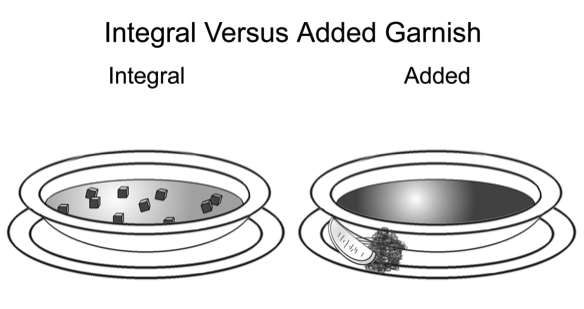
Garniture may take place in two ways. Some garnishes are integrated into the dish as the strawberry compote example suggests. Others are added or placed with the dish to achieve desired results. Both approaches have their place, but integration when possible is generally considered more desirable. This is because integration unifies all the components of a presentation into one dish or creation.
Further examples of integrated garnish are vegetables in soup, nuts in dressings, herb and breadcrumb crusted meats, and whole pieces of protein within a mousseline. Even when components of a dish are somewhat separate, they can be presented in an integrated way. Sometimes elements are stacked, layered, or arranged so closely that the dish with its garnishes become one. Contrast this with a traditional plate presentation where the meat, vegetable, and starch each are placed on a plate divided in thirds. While the vegetable and starch provide visual, textural, and flavorful embellishment to the meat and are considered garnish, this arrangement does not present a unified dish. Instead, there is a plate of individual items.
Integral garniture is planned at the earliest stages of the conception of a dish. This allows the development of potential complex visual, flavor, and textural elements of a dish. A single element of need might be identified and be thoughtfully satisfied while enhancing the other two elements. A dish without crunch can have elements of crunch introduced that are also colorful and flavorful. If more than one element is especially needed in a dish’s design, then all of those elements can be addressed through the possible addition of a single garnish. In this way, a dish can develop complexity without being complicated.
Added garnishes provide supplementary taste, texture, and appearance where these elements are hard to incorporate or where they provide even greater options and dimension. Sometimes the needed elements are not easily incorporated. Other times, great options are simply of the added nature. A cracker for soup is a good example. While there are other garnishes involved with most soup, a cracker provides comfort and satisfaction in its tradition, crunch, flavor, and even visual appeal. A cracker as an added garnish could also display culinary talent and arouse further interest, were it handmade, colorful, and a unique flavor. Other garnishes that might be served “on the side” are those such as a cream, sour cream, compound butter, or other item that would complement the dish but not maintain its structure if presented within the dish. Some colorful coulis are drizzled about a presentation in an artistic way not closely integrated with the main item. This often results in a striking visual presentation and provides complementing flavor and texture as the diner dips bites of the item into the coulis before eating them. Different colored and flavored sauces are often used to “paint” plates in this manner. Added garnishes can also be used in situations where the diner may want to add them in proportions of their own preference. Capers, onions, and chopped egg presented with slices of smoked salmon would be an example.
Chef Tip – Crisp Garnishes
A type of garnish particularly useful in many applications, both integrally or as an added item, is that of thin crisp fruits and vegetables. They add color, crunch, and flavor. Depending on their placement within a presentation, they can add drama and height. Such garnish can be incorporated within certain types of presentations for a contrasting texture that takes the diner by surprise. Currently, techniques of frying and dehydrating vegetables and fruits are often applied to create the thin crisp garnishes that so effectively enhance contemporary presentations.
Fried Vegetable Garnishes
The best vegetables to use for this type of garnish are root vegetables such as potatoes, carrots, and parsnips or different types of onions such as leeks, yellow onions or shallots. It is important to cut these vegetables thinly. Many shapes are possible. With potatoes, for example, thin shapes that work are slices (plain or latticed) or very fine julienne. Leeks also lend themselves to a fine julienne while shallots and yellow onions can be thinly sliced into rings. Carrots and parsnips are interesting if peeled and thinly sliced their entire length. They also look good as a fine julienne.
Once cut, the vegetables should be soaked in water, drained and dredged to coat well with seasoned flour. Shake off the excess flour and deep fry just until the vegetables are stiff and crisp. Season them with salt and pepper. Care should be taken not to fry them too long. Because these foods have been cut so thinly, they will quickly go from crisp to burnt and bitter. Allow for some carryover cooking. Drain on paper towels to absorb the excess oil.
With potatoes, an additional technique that adds even more visual and flavor impact to crisp slice garnishes, is to sandwich whole leaves of herb between two very thin slices of potato before frying them. The result will be opaque chips that allow the herb leaves to be seen.
Herbs and leafy vegetables such as parsley, dill, basil and spinach fry quickly into crisp and tasty garnishes. Simply drop them as is into a deep fryer for just a few seconds. Withdraw from the fryer and drain on paper towels.
Dehydrated Garnishes
Thinly sliced fruits and vegetables can be oven dried to create interesting garnishes. This technique allows the added impact of predetermined shape. As with the frying technique, certain fruits and vegetables work better than others do. Good candidates are tomatoes, eggplant, pineapple, apples and root vegetables.
Preheat the oven to 200°F (93.3°C). Slice the vegetables very thinly. The thin slices may be further cut into shapes such as stars, circles, or crescents. Arrange the slices in a single layer on a parchment paper or silpat-lined sheet pan. Season and spice the slices as desired. Place the pan of sliced fruit or vegetables in the oven to dry until crisp. This will take about thirty minutes but will vary with the thickness and water content of the slices. Remove from the oven and allow to cool to room temperature.
Finally, added garniture includes the gardemanger skills of fruit and vegetable carving. These garnishes are often applied to large displays for visual effect only. Sometimes, as in the case with certain melon carvings, they are not only visually stimulating but also provide the function of containing edible presentation elements such as a fruit salad or sauce. However, some fruit and vegetable carvings, such as radish roses, are small enough to be applied to individual presentations such as a salad. In such cases, they address a variety of garnishing components incorporating flavor, appearance, and textural elements. Vegetable can be cut into interesting shapes before accompanying an entrée. Carvings can also be applied to individual presentation elements such as a canapé on a hors d’oeuvre platter.
Elements of Design
Design is a plan or arrangement of line, form, mass, color, and space in a pattern. The application of design to culinary presentations serves both a functional purpose and provides aesthetic pleasure. Design always implies intention, purpose and a preconception of the end. Culinary design includes the compositional elements of the presentation to inform and stimulate the diner. It is the organization or grouping of the different parts to achieve a unified whole. Such organization involves the colors, forms, planes, and masses on the plate or platter.
A simple and effective approach to plate or platter composition is to practice the principles of balance, unity, focal point, and flow. These four principles address a great deal of design theory and are easy to consider independently.
Balance
The balance principle has broad application. In general, balance means that an issue is not concentrated inappropriately in one way or another. It also means that there are not areas of an issue ignored. Instead, there is a broad, uniform, and comprehensive coverage of items related to the issue. One way to promote balance is to avoid repetition. Balance applies to a range of issues including difficulty, color, cooking technique, foods, food groups, and design. It must also be understood that choices of balance are often subjective and are issues of taste.
Simple dishes can be elegant. In the extreme, they can also be boring. Simplicity does not necessarily imply a lack of skill. In fact, effective simplicity can be very hard to accomplish. Practitioners of successful but simple dishes are generally among the most skilled, talented, imaginative, and artistic culinarians. Yet a bent toward overly simple dishes generally will not inspire a diner. Common sense must prevail on the degree of simplicity. In the extreme, it is poor cooking technique. Failure to apply sauce to an item that needs moisture or flavor does not display simple elegance. Instead, a dry or tasteless item results. On the other hand, overly complex dishes can become busy, impractical, and sometimes just plain silly. An attempt to show off or do too much often backfires. The result may not represent the dish planned. Consistency often suffers as complexity increases. Additionally, the dish may simply take too long to plate and the result is fancy, but cold, food. There is a saying that “it is better to do simple things well than to attempt things more difficult and fail.” Most diners will only appreciate your successes.
When considering the color of a presentation, balance is very important. Dishes of a single hue are uninteresting. Examples of this often involve dishes of “brown food” such as fried food presentations or dark meats with starches. While achieving too much color is more difficult, a dish can become “busy.” Further, in the interest of balance, not every dish should look kaleidoscopic in color. Rather each dish should offer enough variety to be found visually stimulating. This can be done with a number of colors or with a few of varying intensity and contrast. Greens and reds are a pleasing part of many presentations.
Cooking techniques should be varied. This will result in both a more interesting presentation and palate pleasing experience for the diner. Additionally, some combinations will make better culinary and visual sense than others. For instance, serving a poached item with fried food may be nutritionally confusing. The appearance of both of these types of items together may simply “look” wrong.
Nutritional balance is a contemporary concern and is often readily apparent through the mere observation of a presentation. Today’s consumers are educated and discerning. Many know the nutritional values and concerns of specific food items. Some are willing to give on one item if there are other items that meet their nutritional concerns. Others may be “turned off” by the perception that everything is health food. They may want to splurge. Again, balance can appease extremes of nutritional preferences and will likely appeal to the greatest number of diners.Plates and meals should offer a selection of foods without redundancy of items. Using an ingredient more than once, especially for some design characteristic such as color, is not creative or stimulating. Diners quickly spot repetitive use of ingredients. Again, variety will prove more interesting. An assortment of food items will also present more nutritional balance and options for other balance issues such as color and texture. Diners are looking for nutritional balance, so the consideration of the various food groups also is important.
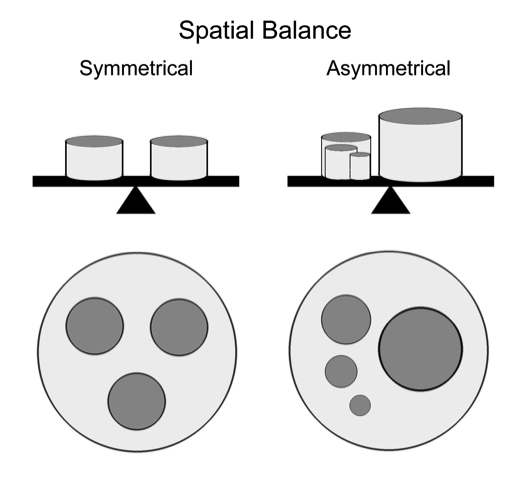
Finally, physical or spatial balance is an important consideration in the application of presentation and plating techniques. The plate or platter should look balanced. This is accomplished by arranging the food in a manner that spreads the mass of the items evenly about the plate or platter. Spatial balance can be accomplished in a symmetrical or asymmetrical way. The items of a plate or platter may lend themselves to either or both methods. Symmetrical presentations lay out the food in a manner that result in one side of the plate mirroring the other. Asymmetric presentations are varied in nature but, if balanced, nevertheless spread the mass of product evenly about the plate or platter. This is accomplished by balancing a large item on one side of the presentation with a number of smaller items equal to the mass of the large one on the other side of the presentation.
Focal Point
The focal point of a presentation is the area or item to which the eye is automatically drawn. Purposeful control of this point draws attention to items that would be desirable to highlight. Such control is achieved by artfully manipulating such concepts as color, height, placement, and the flow of the presentation. In this way, the presentation theme may be identified, as well as the important ingredients and cooking techniques involved. Often the main ingredient of the plate is highlighted. Attention is frequently directed to expensive or unique ingredients.
The existence and location of the focal point of a presentation is determined by the placement and relationships of the various items, the height of certain items and the color intensity and contrast relationship of items. Sometimes, the presentation designer uses additional garnishes to create height and color. Item size also plays a role as the eye is drawn to larger pieces.

Flow
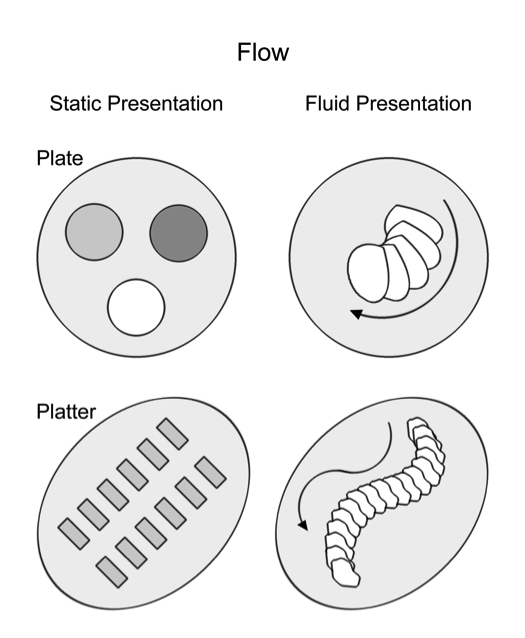
The sense of movement produced in a presentation is called flow. Patterns of flow create a dynamic presentation that makes a design interesting. Controlled flow allows a presentation designer to develop the sense of movement. Flow may be used to direct the diner’s eye over the presentation and to the focal point. Asymmetric presentations generally allow for the development of flow better than symmetric ones, especially on small presentations such as a plate. Symmetric plate presentations often cause eye movement to stop in the center of the plate. While this is sometimes useful to highlight an important item of the presentation, flow can be used to direct the diner’s eye over all the items of a presentation. Presentations with flow are said to be fluid or active. Those without are static or stationary and may lack vitality.
Strong Lines
The effective use of strong lines are employed in order to produce professional looking presentations of optimum appeal, regardless of the design. Presentations containing strong lines are crisp, clean, and more visually satisfying. Why is this so? Strong lines are easy on the eye because they are predictable and not confusing. They are bold, catching the eye and directing it. In fact, the definition of a strong line could simply be stated as one that is striking and predictable. It makes a strong statement of direction. Such a line is appealing and stimulating, absorbing the attention of the viewer. Such attention is necessary for the culinarian to make his or her presentation intentions optimally understood. Finally, line strength within a presentation suggests superior workmanship and quality ingredients.
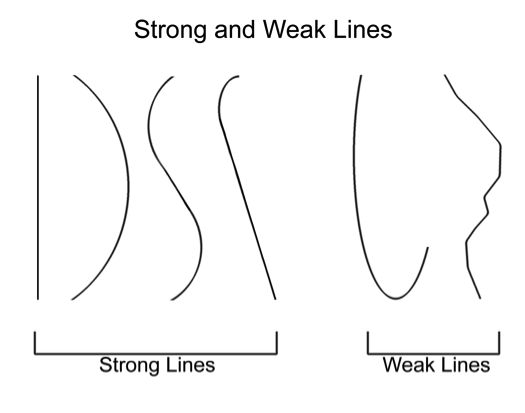
The strongest line is simply a straight one. It sets a strong definite direction. Other strong lines are those with a pattern that is understood. Smooth consistent curves are also predictable and suggestive of direction. Even a “J” shaped line is often presented in a strong manner. Sometimes, however, it occurs in an arrangement when the edge of the presentation was reached before intended product has run out. In such a case, the curve happens abruptly and unpredictably and is not indicative of a strong line.
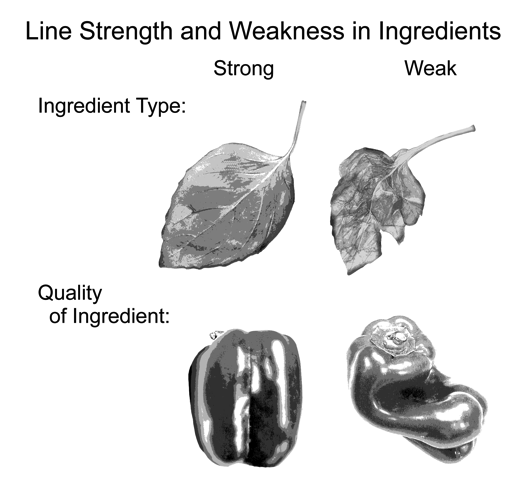
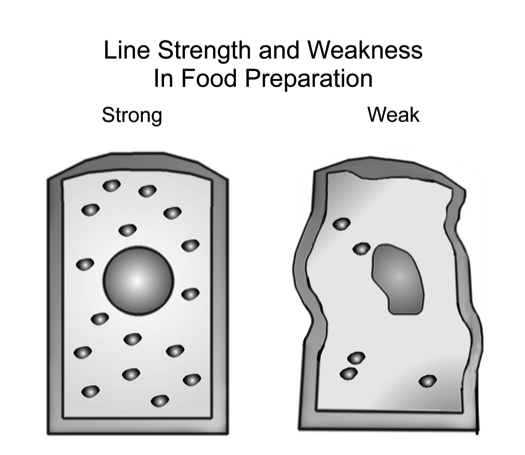
Presentations can contain strong lines in a number of ways. They, of course, may contain a flow of items laid out in a strong manner. Such a layout is most evident in platter presentations due to their size and the number of items usually involved. The elements within the presentation may also contribute or detract from the strength of its lines. Ingredients can demonstrate strong line. A basil leaf, for example, used to garnish a dish of pasta might be fresh and flat with crisp, clean lines at its edge or it may be crumpled or withered and without a strong shape. The way an item is fabricated, cooked, or sliced can affect the strength of its line. Proteins cut in a ragged manner, items overcooked until they lose their shape, or food sliced unevenly all result in weak, unpredictable, and unsightly lines. For these reasons, the selection, care, and skill a culinarian applies to the ingredients and elements of a presentation can have a great impact on the strength of lines it will ultimately contain.
Applying Presentation Concepts
Bringing together all these concepts into the most pleasing and effective presentation is a challenging but achievable objective. Each concept must be thoughtfully applied one step at a time. In this way, the application is not overwhelming. This method further insures that presentations are developed from the ground up and are foundationally sound. A presentation developed in any other way will likely suffer from results that are less than professional. It might also display evidence of “fixes” or patches that were applied later in the process to address areas of lack.
To avoid such pitfalls and achieve the best presentations possible, consideration and skill should be applied to each of the following steps, successfully completing one before the next is undertaken. The steps are:
- Complete and appropriate planning (design) of a dish or presentation
- Selection and maintenance of quality ingredients
- Skilled preparation and fabrication of the ingredients
- Precise combining of ingredients into formula elements
- Skillful assembly of formula and ingredient elements
- Proper application of cooking methods
- Proper slicing, unmolding, and other post cooking finishing procedures
- Attractive and functional placement of individual elements into a presentation
Without a complete and credible plan the remaining efforts will occur without direction and focus. Wasted efforts and ingredients will likely result. The outcome of a presentation without a plan is by nature happenstance and will probably be substandard. With a plan, the culinarian knows what to purchase, how to fabricate, assemble, cook, slice, and layout to achieve a presentation of predetermined outcome. Each step’s successful completion is necessary to attain the final positive result. Shortcuts will only detract from that result. Pressing the point further down the list, superior elements cannot be created with poorly prepared ingredients. Fine cuts cannot be made from overcooked product. A high-quality display cannot come from elements that were poorly fabricated, cooked, and sliced. It is therefore imperative to address each step sequentially with a commitment to quality and consideration for the relevant concepts of design addressed in this chapter.
In addition to the previously mentioned purposes of enticing the diner, informing the diner, and presenting the array of culinary elements as a whole, a number of other outcome objectives are possible.
Theme and Style
The suggestion of theme and style are objectives met through presentation. For example, displaying ingredients and preparations associated with a cultural flavor profile is one way to suggest theme. Most diners will recognize the presentation of Oriental stir-fries, Italian pastas, or Cajun gumbos for what they are and understand the menu theme within which they are presented. Expensive ingredients are often associated with elegance and sophistication while inexpensive ingredients suggest food styles more familiar and comfortable. Petite and precise portions could be used to suggest elegance, elements of fine dining, modernism, and minimalism. They may also be seen as pretentious, even stingy. Large portions might suggest casualness, good value, home-style cooking, or comfort food. They could also be associated with over indulgence and waste. The size of portions could become a theme in itself, associated with the establishment. Bright colorful food and presentations could suggest a festivity, cheerfulness, freshness, and appeal to youthfulness. Muted colors are more somber and may suggest a solemnity, seriousness, sophistication, and appeal to maturity.
The selection of cooking methods used for a presentation can work in the same manner. Offering fried foods may suggest a casual theme or one less healthy, while a menu with poached foods might imply fine dining and healthy cuisine.
Most implications of theme or style are neither fundamentally good nor bad. An understanding of their possible composition is important in order to align presentation results with intentions. This understanding not only promotes the attainment of desired results but also serves to avoid those that are not. Controlled presentations are refined, eye-catching, and appropriate. The alternative runs the risk of boring or even offending the diner.
Practicality and Function
Presentation outcomes must consider practical and functional issues. They should be constructed in such a way, for example, that promotes heat retention in hot foods. Presentations that separate hot food elements are less likely to stay hot. The elements are not insulted from the cooler atmosphere. Arranging hot food in dense proximity causes less exposure to the cooling atmosphere while the mass of hot food maintains its heat longer.
Exposure to air by separating presentation elements will also cause the food to dry out more quickly. Appearance, texture, and taste could suffer. This is true of room temperature or chilled foods as well as those that are intended to remain hot. If foods are to remain exposed for longer periods, such as in a buffet, drying out of the food items could become an issue.
Other issues of practicality when designing a presentation are consideration of the degree of effort, the consumption of resources, and the cost necessary to produce it. Any of these areas could be found prohibitive for a particular presentation. Perhaps, if needed (such as in the case of an a la carte entrée), the dish could not be produced quickly enough to suit the diner. It may take too much time to construct and, if hot, become cold. A presentation could be so complicated that its consistent reproduction would be difficult. Even more pragmatically, can the server carry the presentation, if needed, without destroying it? The amount of effort and cost to produce and employ the presentation must be considered in relation to other demands on those producing it. Is the effort and cost disproportionate or of sufficient benefit?
Functional issues include consideration of elements such as bones within a presentation. Though not edible, they can add drama and information to a presentation. Lamb chops without their bones might be less eye-catching and could prove confusing to the diner. On the other hand, they would be easier to eat. Skin of poultry and fish presents similar considerations. While skin can be edible, depending on how it is prepared, many diners choose not to consume it. The creator of a presentation must consider what the inclusion of skin adds to the presentation in terms of appearance, taste and texture. After all, it can be crisp and colorful. Again, there are not absolute approaches, just informed ones.
A garnish is often termed either functional or nonfunctional. A functional garnish is one that can be eaten and fits within the presentation concept. It is not added only to fix a single lacking element of a presentation. A sprig of parsley, added only for a splash of color but providing no other contribution to the dish, is considered a nonfunctional garnish. An herb sprig, used in the same manner, but of a flavor found within the dish or presentation additionally provides information to the diner as well as visual appeal.
The Mechanics of Presentation Design and Implementation
Once well planned, a presentation is successfully carried out through organization and action. Organization is another name for mise en place or preparation. Ingredients and equipment are assembled in a fashion that supports their efficient utilization. The more complicated a presentation, the more important this concept becomes. This is because time is of the essence in order to have a presentation result that is successful, fresh, and practical.
Issues of food quality have already been discussed. Equipment concerns are equally important. Necessary tools should be in good repair and of the appropriate size. Knives should be sharp. Clean definitive cuts, strong lines, and intended shapes and sizes are made with sharp and appropriate utensils. When working, workflow consideration promotes additional efficiency in production. For many, this means working from left to right. In any case, it means having ingredients and equipment within easy reach and a plan of production. A culinarian can then work without hesitation and interruption.
Sequencing
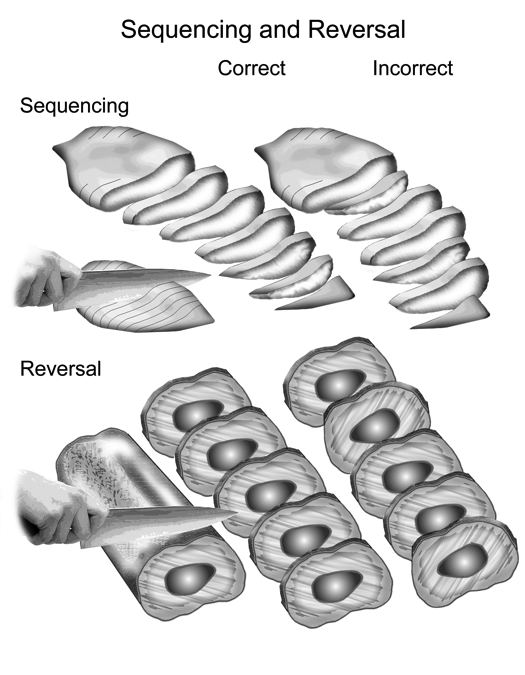
Presentation cuts made to products, whether from a simple breast of cooked chicken or an elaborate pate, should be displayed in the order from which they were sliced from the whole. This results in a presentation that has a natural look to it. Slices presented out of order will be quickly spotted and distract from the entire presentation. A flow out of sequence can result in a line of irregular size progression. Such a line would be weak and ineffective for reasons previously discussed.
To facilitate the proper display sequence, care should be taken when slicing to maintain the order and orientation of each cut. This can be accomplished by laying out the slices on a work tray in an organized fashion as they are taken from the main piece. Each slice should be laid in a uniform way making sure that all slices are laid with both the same face and top orientation. Such a practice will keep the slices from becoming reversed or turned. This practice insures that any pattern on the face of the slices, such as that provided by marbling or garnish, or irregular shape of the slices is shown in a natural and non-distracting progression when displayed.
Access
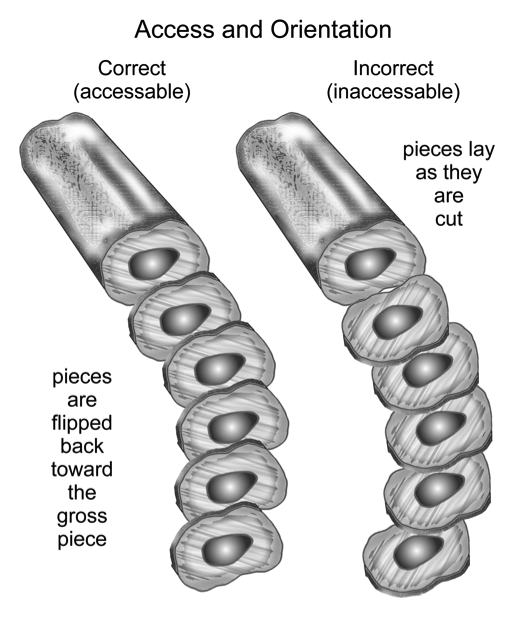
When assembled on a plate or platter, the slices should be laid in a manner that carefully maintains the slice orientation and considers the diner’s access to those slices. Slices should be shingled so that the slice presented closest to the diner is always on top for easiest access. In this way, the diner does not have to pull a slice from underneath a pile of other slices. Such a layout generally means that the slices are laid in reverse order from which they were sliced, with the last slice being laid first and to the back. The slices are also laid face up rather than face down as they are sliced.
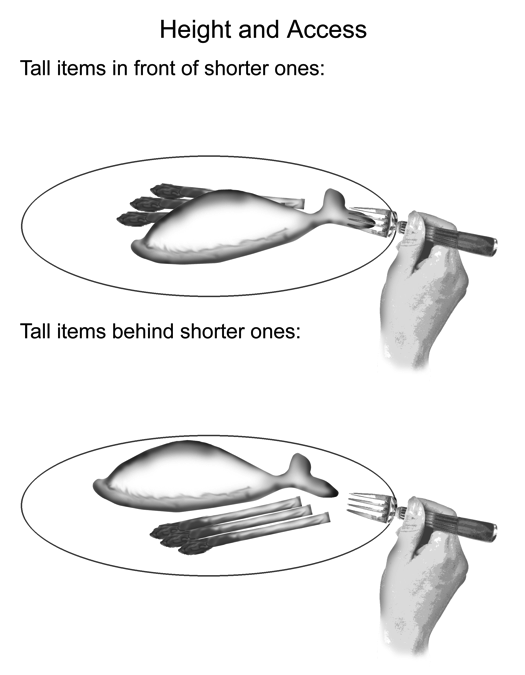
Presentations without a flow of similar individual items, such as slices, must also consider diner access. Many contemporary presentations are so confusing that the diner has little or no idea how to approach it. Some presentations are tall and tenuously balanced, causing the diner to address it with trepidation. Sometime the major element or other important elements of a presentation are not visible or accessible because they are hidden by other elements of the presentation. The display of all elements of the presentation is important to the diner, especially those key elements that serve to define it. If a diner ordered beef, beef should be apparent when served. Elements can be made inaccessible by being placed behind other taller elements. In general, tall elements should be placed to the back of a presentation or, at a minimum, should not keep the diner from other elements of the presentation.
Conclusion
Presentation skills are important to the culinarian. They often separate the professional from the amateur. They combine creativity with workmanship, artistic acumen, and license with common sense. They are developed, over time, from education, personal experience, and exposure to the experience of others. Individual contributions can be made through personal style applied to the concepts of presentation design.